
Inventory Allocation: Methods and Strategies for Ecommerce Sellers
 October 5, 2026
 Yashwardhan Singh
 0 Comments
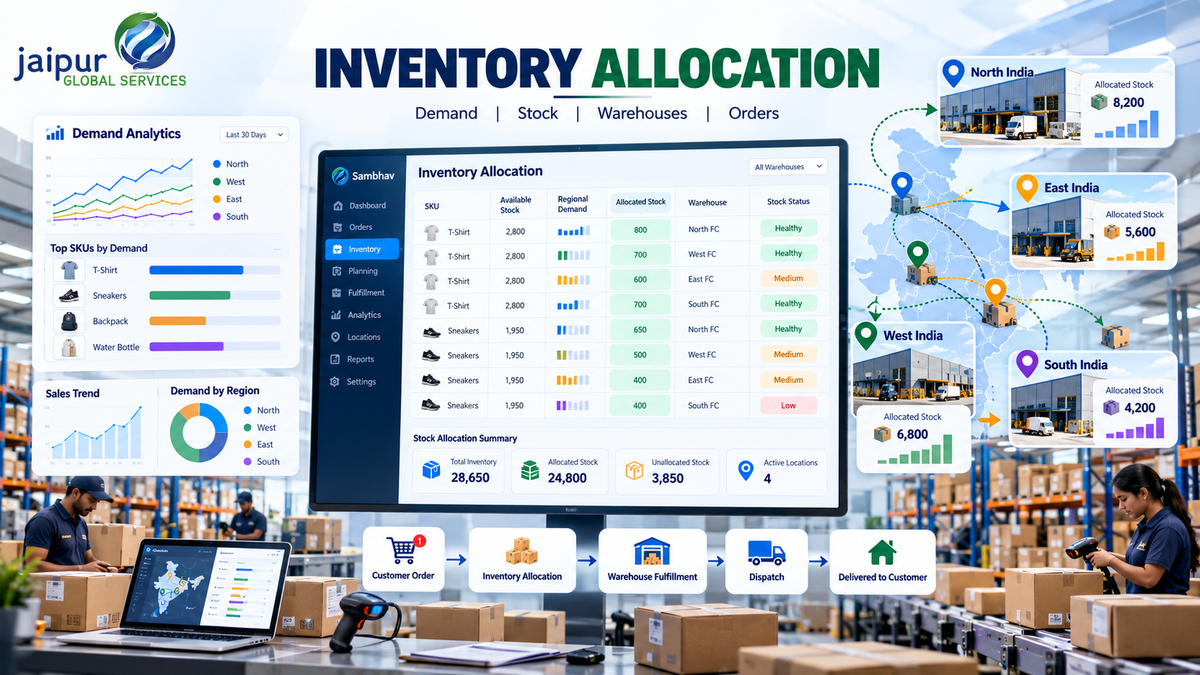
A seller has 1,000 units of a product. Orders are coming in steadily, so stock shouldn't be a problem. But 700 of those units sit in one warehouse, while most orders come from a region served by a different location. Sales slow down, customers wait longer, and the seller is left wondering why, with enough stock on paper, orders still aren't going out on time.
This is the real problem behind inventory allocation. Having enough stock is not the same as having stock in the right place. JGS (Jaipur Global Services) sees this pattern often with sellers who are growing fast but haven't yet matched stock placement to where demand comes from.
What Is Inventory Allocation?
Inventory allocation is the process of deciding how much stock should be kept, reserved, or sent to each location, channel, order, or demand area. It answers a simple question: of everything you have, what goes where?
This matters more as a business grows. A seller with one warehouse and one channel barely needs to think about it. But once you're selling across multiple marketplaces, running several warehouses, or managing many SKUs, allocation becomes a daily decision, not a one-time setup. Platforms like Sambhav exist partly because this gets harder to track by hand as a seller scales.
Why Inventory Allocation Matters for Ecommerce Sellers
Poor allocation shows up as real, avoidable problems: stockouts in regions with strong demand, excess stock sitting where it barely sells, missed sales because the right product wasn't nearby, higher storage costs for slow movers, fulfillment delays while stock is moved from the wrong place, and poor visibility into what's actually available where.
Total stock and correctly placed stock are two different things. A seller can be fully stocked overall and still lose sales every day because inventory isn't sitting where the orders are. This is where JGS's approach to ecommerce operations helps, since it treats inventory as something to plan around actual demand, not just a number to track.
Inventory Allocation Methods
There isn't one correct method. The right one depends on your products, demand patterns, warehouse network, and order volume. Here are the common approaches sellers use.
Demand-based allocation sends more stock to locations where demand is genuinely stronger, based on current order patterns rather than guesswork.
Historical sales allocation uses past sales data to guide placement. It works well for products with steady, predictable demand.
Regional allocation places stock according to where customers in each region are actually buying from, rather than splitting stock by convenience.
Priority allocation reserves inventory for important orders, customers, or channels, based on rules the business sets — useful when certain accounts or channels need guaranteed availability.
Safety stock allocation keeps extra inventory in locations where demand is unpredictable or supply risk is higher, so a sudden spike doesn't cause a stockout.
Proportional allocation divides inventory by a set percentage or expected demand share across locations.
None of these methods is universally best. Many sellers end up using a mix, depending on the product and the season.
Inventory Allocation Strategies
Methods are the "how." Strategies are the habits that make allocation actually work: allocate based on real, current demand, not assumptions; keep fast-moving SKUs closer to where demand is strongest; avoid spreading slow movers across every location; hold safety stock for important SKUs; review allocation regularly, not just once; factor in replenishment time before deciding quantities; consider product size and storage cost, not just sales numbers; account for seasonal shifts; track sales region by region, not just overall; and base decisions on current data rather than last year's pattern alone.
Sambhav's role here is to make this ongoing review easier, by pulling sales, order, and inventory data into one place instead of several separate reports.
What Is Soft Allocation of Inventory?
Soft allocation generally means stock is temporarily reserved or planned for a particular order, channel, or location, without being permanently committed the way a final allocation is.
Simple example: a seller has 100 units. Based on expected orders from one channel, 20 are softly allocated to it. If demand doesn't materialize or an order is cancelled, those 20 can usually still be redirected elsewhere, since they were never locked in.
The exact meaning and workflow of soft allocation can vary between inventory systems, businesses, and software platforms — there isn't one fixed industry definition.
Hard vs Soft Inventory Allocation
Hard allocation means stock is firmly committed to a specific order, channel, location, or requirement. Once hard-allocated, it generally isn't meant to be moved elsewhere without a deliberate change.
Soft allocation means stock is held or planned for a requirement, but can usually still be adjusted before it becomes final, depending on the system in use.
A simple example: if a customer places a confirmed order, that stock is typically hard-allocated. If you're planning stock for an expected seasonal spike that hasn't happened yet, that's closer to soft allocation — reserved in plan, but not locked.
Inventory Allocation Across Multiple Warehouses
This gets harder once a seller operates more than one location. Say a seller runs warehouses in North, West, and South India. Demand isn't equal across these regions, so splitting stock evenly rarely works well.
To decide where stock should go, sellers look at regional demand, SKU-level sales velocity, current inventory levels, replenishment time, warehouse capacity, and order volume at each location. This is the thinking behind the JGS Multi-Location Fulfilment Guide, which covers planning stock placement across regions based on actual demand rather than assumption.
Sambhav supports this with regional order routing and demand-based stock allocation, drawing on SKU demand and sales velocity across locations.
How Data Improves Inventory Allocation
Good allocation decisions come from data, not instinct: sales by SKU, sales by region, order volume, current stock levels, sales velocity, seasonal trends, return patterns, replenishment time, and warehouse capacity.
Sellers don't need to guess where stock should go — most of this already exists in their sales history. The challenge is pulling it together in one place, which is where Sambhav's analytics, forecasting, and inventory reporting help, connecting this data to the multi-location picture.
Common Inventory Allocation Mistakes
- Splitting stock equally between warehouses regardless of demand
- Ignoring actual regional demand data
- Moving stock based on assumptions rather than numbers
- Keeping slow-moving products at every location
- Ignoring replenishment time
- Not keeping safety stock for important SKUs
- Ignoring seasonal demand shifts
- Looking only at total inventory, not where it sits
- Poor SKU-level tracking
- Not reviewing allocation after demand changes
Most of these come from treating allocation as a one-time task rather than something needing regular review — the kind of ongoing tracking JGS and Sambhav are built to support.
How JGS Helps Ecommerce Sellers With Inventory and Operations
Inventory allocation doesn't sit on its own — it connects to catalog management, order management, marketplace operations, fulfillment, and business planning. JGS works with sellers across these related areas, so inventory decisions aren't made in isolation.
Clean, accurate SKU data makes allocation far easier, which is why JGS Catalog Management Services often comes up alongside inventory planning. For sellers managing full marketplace accounts, JGS Account Management Services covers the broader operational side.
How Sambhav Can Help With Inventory Allocation
Sambhav brings ecommerce data and operational workflows into a connected environment: inventory control, sales and performance analytics, demand forecasting, order management, catalog management, and multi-location fulfilment with regional order routing and demand-based allocation.
The basic workflow: sales data leads to understanding demand, which leads to inventory planning, allocation, fulfillment, monitoring, and reallocation as things change. Technology makes each step easier to see and act on, but the actual planning decisions still depend on the seller's own business needs. Sambhav doesn't guarantee the "best" allocation automatically — it gives sellers clearer information to decide with.
Simple Inventory Allocation Checklist
- Know your current demand
- Check SKU-level sales, not just totals
- Check regional demand patterns
- Understand each warehouse's capacity
- Review replenishment time for each location
- Keep safety stock where it's genuinely needed
- Avoid overstocking low-demand locations
- Review seasonal demand shifts
- Monitor orders and returns regularly
- Revisit your allocation plan often, not just once
Conclusion
The goal of inventory allocation isn't to keep more stock everywhere. It's to keep the right stock, in the right place, at the right time. Done well, it can help reduce stockouts, cut unnecessary storage cost, and fulfil orders faster — though results still depend on demand patterns, product type, warehouse setup, and how consistently the plan is followed.
If you're managing stock across multiple warehouses or marketplaces, it's worth checking how your current allocation compares to where demand actually is. JG Services (Jaipur Global Services) and its platform Sambhav are built to support exactly this — bringing sales, inventory, and location data together so allocation is based on facts, not guesswork.