
Distributed Order Management: A Guide for Ecommerce Sellers
 October 8, 2026
 Yashwardhan Singh
 0 Comments
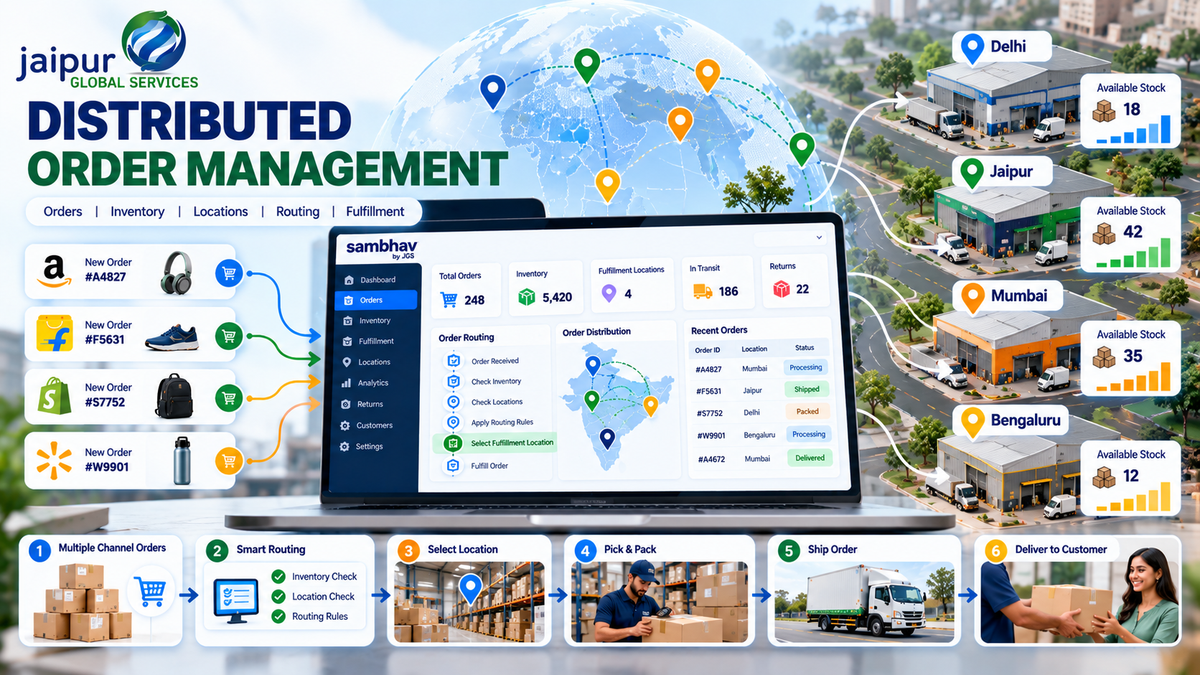
A seller gets orders from Delhi, Chennai, and Pune in the same hour. The same product sits in three different warehouses. Processing the orders is the easy part. The hard part is deciding which location should ship each one, and keeping stock and order status correct everywhere while it happens.
This gets harder when orders also come from Amazon, Flipkart, Shopify, and Walmart. The seller needs to know where the stock is, which location should fulfill the order, whether that location can handle it, and how to keep everything updated. That is the problem distributed order management tries to solve. JGS (Jaipur Global Services) works with sellers who face this as they grow beyond one warehouse, and Sambhav, its seller platform, was built with these workflows in mind.
What Is Distributed Order Management?
Distributed order management is a way of coordinating orders, inventory, warehouses, fulfillment locations, sales channels, shipping, and returns across a network of locations.
Instead of looking at each warehouse separately, you get one connected view. A distributed order management system helps you see what stock exists where and decide how each order should move. The basic flow is:
Customer order → inventory availability → location selection → order orchestration → fulfillment → tracking → returns
How Distributed Order Management Works
- Order arrives from a marketplace, website, or another channel.
- Inventory is checked across suitable locations.
- Rules are applied, such as stock levels, customer location, warehouse capacity, and business rules.
- A location is selected for the order.
- The order is fulfilled. The chosen location picks, packs, and ships it.
- Status is updated for both the order and the inventory.
- Returns are tracked in the same flow.
Sambhav follows a similar idea by bringing order and operational information into a more centralized place, so sellers are not checking five screens to answer one question.
Distributed vs Traditional Order Management
In a traditional setup, orders are often handled separately across marketplaces, websites, warehouses, and spreadsheets. Each place has its own version of the truth, and the information rarely matches.
A distributed approach focuses on coordinating orders and inventory across locations and channels together. The goal is better coordination, not just more software. JGS often sees sellers add tools one by one and end up with more disconnected data, not less.
Distributed Order Fulfillment
Distributed order fulfillment means fulfillment can happen from multiple locations instead of one central warehouse. Say a seller holds stock in Jaipur, Mumbai, and Bengaluru. An order from a Bengaluru customer may be fulfilled from the Bengaluru location if it has stock and fits the seller's rules.
Sellers usually consider this model as order volume and reach grow. It does not suit everyone, since each extra location adds cost and effort. The JGS Multi-Location Fulfilment Guide explains when it makes sense and how sellers can plan it.
Why Inventory Matters in Distributed Order Management
Good order decisions depend on good inventory data. If the system thinks a location has ten units and it has two, the order goes to the wrong place.
Sellers need to track:
- SKU-level visibility and available stock
- Reserved stock and safety stock
- Regional demand and stock movement
- Replenishment and warehouse capacity
Wrong SKU data makes all of this harder, which is why JGS Catalog Management Services matter for sellers running multiple locations. Sambhav's inventory and centralized data features aim to keep this information connected across locations.
What Is a Distributed Order Management Platform?
A distributed order management platform is the tool that brings these pieces together. Sellers may look for centralized order visibility, inventory visibility, multi-location fulfillment, order routing, returns management, SKU-level data, marketplace connectivity, reporting, analytics, and exception handling.
Exact features vary between platforms. Not every seller needs every feature, so start with your own gaps. A seller with two warehouses and one channel needs far less than one with six locations and four channels.
Distributed Order Management Software
Distributed order management software becomes useful when manual coordination gets hard. Typical benefits include automation of repeat tasks, centralized information, order routing, inventory visibility, location-level control, fewer manual checks, better monitoring, and easier scaling.
Software does not fix bad data or unclear rules. If your inventory counts are wrong or you have no routing rules, the software will simply move the confusion faster.
What Are Distributed Order Management Vendors?
When sellers compare distributed order management vendors, they are comparing companies that offer these systems. Useful points to check:
- Supported marketplaces and integrations
- Warehouse and location support
- Inventory visibility and order routing
- Returns handling and reporting
- Ease of use and scalability
- Support, data security, and total cost
No vendor is best for everyone. The right fit depends on your channels, locations, order volume, and budget.
What Is an ADMS System?
You may see the term ADMS system in searches. It can mean different things depending on the industry and software, so do not assume it always points to one ecommerce product. If a vendor uses the term, ask them directly what they mean by it and what it covers.
SaaS Distributed Order Management System
A SaaS distributed order management system runs in the cloud, so teams can open order and operations data without relying only on local systems. Possible benefits include centralized access, easier updates, scalable operations, multi-location visibility, and access for teams in different places.
These benefits depend on the software, integrations, data quality, and your setup. Check security and reliability details with each provider rather than assuming.
Smart Routing in Distributed Order Management
Order routing sits at the center of this model. The simple flow is: order → check locations → compare options → select location → fulfill.
The comparison usually looks at customer location, inventory availability, warehouse location, fulfillment capacity, order priority, shipping needs, and business rules. Sambhav supports regional order routing as part of its multi-location fulfillment capability, and the result depends on how the seller sets things up.
How JGS Helps With Distributed Operations
Distributed order management works best when product, inventory, and order data is organized first. JGS supports ecommerce sellers with account management, catalog management, inventory and order flow, marketplace operations, performance monitoring, analytics, and finance and reconciliation.
For marketplace-level support, JGS Account Management Services is a good starting point, and Flipkart sellers can look at JGS Flipkart Account Management. Since multiple locations add fees, settlements, and returns to track, accounting and taxation support helps keep profit visible.
How Sambhav Supports Distributed Ecommerce Operations
Sambhav by JGS gives sellers a more centralized view of order data, inventory, catalog, analytics, CRM, finance, and fulfillment workflows. Its multi-location fulfillment covers multiple fulfillment locations, demand-based stock allocation, regional order routing, SKU demand, sales velocity, regional trends, and real-time monitoring across locations.
The workflow is: customer order → inventory check → location decision → fulfillment → tracking → returns.
Actual routing depends on configuration, connected channels, inventory availability, and seller requirements. Sambhav does not replace marketplace or warehouse systems, and it cannot promise faster delivery or lower costs on its own.
Common Distributed Order Management Mistakes
- Poor inventory data
- Incorrect SKU mapping
- Too many disconnected systems
- No clear routing rules
- Ignoring returns
- Not tracking stock by location
- Using spreadsheets for large order volumes
- Not reviewing exceptions
- Choosing software without checking marketplace needs
Simple Distributed Order Management Checklist
- How many sales channels do I use?
- How many fulfillment locations do I have?
- Can I see inventory by location?
- Can orders be routed using clear rules?
- Can I track order status?
- Can I manage returns?
- Can my team see the same data?
- Can the system scale with order volume?
- Can it connect with my marketplaces?
Sellers working with JGS or using Sambhav can use this list to see where their data is still scattered.
Conclusion
Distributed order management is about bringing together orders, inventory, locations, routing, fulfillment, and returns, so a spread-out operation is easier to coordinate. It does not need to be complicated, but it does need clean data and clear rules.
If you manage stock across several locations or channels, it may be worth reviewing how connected your setup really is. You can explore JG Services (Jaipur Global Services) or see how Sambhav supports multi-location operations.